Russian 2S7M Self-Propelled Gun (Trumpeter)

This is the Trumpeter 05592 kit in 1/35 scale, of the ‘Russian 2S7M Self-Propelled Gun’.

Soviet 2S7M Self-Propelled Gun

The 2S7 Pion (“peony”) or Malka is a Soviet self-propelled gun. “2S7” is its GRAU designation.

It was identified for the first time in 1975 in the Soviet army and so was called M-1975 by NATO (the 2S4 Tyulpan also received the M-1975 designation), whereas its official designation is SO-203 (2S7). Its design is based on a T-80 chassis carrying an externally mounted 2A44 203 mm gun on the hull rear.

      It carries 4 203 mm projectiles for immediate use while the remainder is carried by another vehicle and it is capable of firing nuclear ammunition of the same caliber. The gun has a range of 37,500 m but the range can be extended to 55,500 m by using RAPs (Rocket Assisted Projectiles). The Pion has also been the most powerful conventional artillery piece since entering service in 1983.

Source: Trumpeter website

Manufacturer

German 128mm PaK 44, Krupp (Trumpeter)

This is the Trumpeter 02317 kit in 1/35 scale, of the ‘German 128mm PaK 44’.

German 128mm PaK 44 (Krupp)

The 12.8 cm Pak 44, (Panzerabwehrkanone) was a German anti-tank gun used during World War II.

It was designed as a result of experiences on the Eastern front in 1943. The German army had encountered the Russian 122 mm guns and had issued a requirement for a similar weapon.

Development initially concentrated on a field gun known as the Kanone K 44. However once heavier Russian armour such as the IS-2 started to appear the design requirements were altered to include an anti-armour role.

Source: Trumpeter website

Manufacturer

German 128mm PaK 44, Rheinmetall (Trumpeter)

This is the Trumpeter 02312 kit in 1/35 scale, of the ‘German 128mm PaK 44’.

German 128mm PaK 44

The Rheinmetall 12.8cm K44 L/55 was a German anti-tank gun used during World War II. It was designed as a result of experiences on the Eastern front in 1943.

The German army had encountered the Russian 122 mm guns and had issued a requirement for a similar weapon. The first prototype guns were delivered for testing in late 1944.

After initial tests the Rheinmetall design was dropped and development continued with the Krupp design. However the service tests showed that a towed anti-tank gun weighing nearly 11 tonnes was impractical so the towed design was terminated.

Source: Trumpeter website

Manufacturer

German Krupp/Ardelt Waffentrager 88mm PaK 43 (Trumpeter)

This is the Trumpeter 01587 kit in 1/35 scale, of the ‘Krupp/Ardelt Waffentrager 88mm PaK 43’.

Krupp/Ardelt Waffentrager 88mm PAK-43
Towards the last months of WWII the Ardelt/Krupp design team concepted the Leichter Einheitswaffenträger 8,8 cm IFH, which based on chassis components already used in the Hetzer and 38 D vehicle series with the aircooled Ⅴ 12 Tatra Diesel engine.

As only a minimum of protection was intended, the weight could be limited to 15 tons to give a higher mobility.

Till end of the war only few prototypes were built.
Source: Trumpeter website

Manufacturer

Where I got it

German Panzerkampfwagen II Ausf. A/B/C (French Campaign) (Tamiya)

This is the Tamiya 35292-3200 kit in 1/35 scale, of the ‘German Panzerkampfwagen II Ausf. A/B/C (French Campaign)’.

German Panzerkampfwagen II Ausf. A/B/C (French Campaign)

An Important Blitzkrieg Player – In the early days of WWII, the Pz.Kpfw.II Ausf.A/B/C was one of the main components of Germany’s armored forces as they smashed through Europe with their Blitzkrieg tactics.

Despite having only 15mm of armor protection and a 20mm main gun, this compact tank was on the front lines as adequate numbers of Pz.Kpfw.III tanks were not available.

For the invasion of France, many tanks featured additional bolt-on 20mm armor plating on the hull and turret.
Source: Tamiya website

Manufacturer

Where I got it

German Hanomag Sd.Kfz.251/1 (Tamiya)

This is the Tamiya 35020-2200 kit in 1/35 scale, of the ‘German Hanomag Sd.Kfz.251/1’.

German Hanomag Sd.kfz 251/1

History

In 1938, the German Army decided to develop an armoured personnel carrier on the basis of the 3-ton half track (HL-KL-9p). Hanomag Hannoversch Machinenbau (AG) in Hannover was ordered to develop the running gear and Bussing-NAG in Berlin was to develop the superstructure to be armoured.

Design work was hastened on the model of existing armoured cars and a prototype was completed at the end of 1938. The Germans tested the prototype in the Kumahsdorf Proving Ground and accepted it for mass production. Thus was born the Armoured Personnel Carrier Hanomag Sd.Kfz.251/1 which, we may safely say, was a synonym for the German mechanized corps that showed activity in all battlefields throughout the war.
Source: Tamiya website

Manufacturer

Where I got it

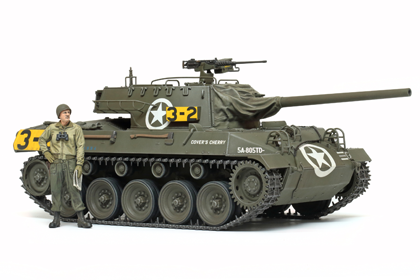
American Tank Destroyer M18 Hellcat (Tamiya)

This is the Tamiya 35 376-3800 kit in 1/35 scale, of the ‘American Tank Destroyer M18 Hellcat’.

American Tank Destroyer M18 Hellcat

History

The M18 Hellcat was an American tank destroyer developed to counter the German Army tanks, and it featured an open top design turret and powerful 76mm gun, plus a main gun breech rotated 45 degrees around the gun barrel to save space in the turret interior.

It had a compact, lightweight hull, automatic transmission and the first torsion bar suspension seen on U.S. armor. Its radial 9-cylinder engine at the hull rear was capable of 80 km/h maximum speed which was the highest speed among tracked vehicles during WWII.

The production started in July, 1943 and the Hellcat was in service for the first time at the Italian Front in 1944. After that, this tank destroyer was deployed in the North-Western European and Pacific War theaters, notably besting the German Army tanks with super performance and firepower based on hit-and-run tactics. The Hellcat contributed to U.S. victory as a pioneer of tank destroyers.

Source: Tamiya website

Manufacturer

Where I got it

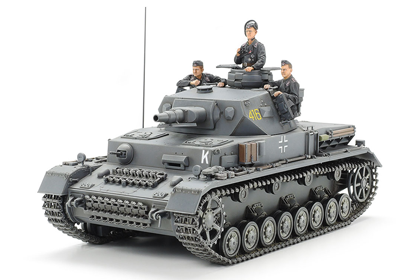
German Panzerkampfwagen IV, Ausf. F (Tamiya)

This is the Tamiya 35 374-4000 kit in 1/35 scale, of the ‘German Panzerkampfwagen IV, Ausf. F’.

German Panzerkampfwagen IV, Ausf. F

History

In service throughout WWII, the Pz.Kpfw.IV was a durable servant to the German Army.

The Ausf. F was the last variant to utilize a short-barreled gun: the L/24 7.5cm KwK37, and was also equipped with wider tracks to cope with the increasing thicknesses of armor.

470 Ausf. F Pz.Kpfw.IVs were manufactured between May 1941 and February 1942, mainly seeing action on the Eastern Front and in North Africa and taking on enemy armor such as the Soviet KV tanks and the British Matilda.

Source: Tamiya website

Manufacturer

Where I got it

Russian Heavy Tank KV-2 (Tamiya)

This is the Tamiya 35 375 kit in 1/35 scale, of the ‘Russian Heavy Tank KV-2’.
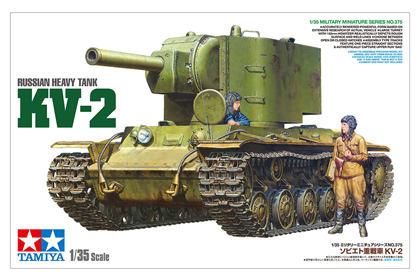
Russian Heavy Tank KV-2

History

In December 1939 the KV-1 was officially adopted by the Soviet military; it was followed by the KV-2, a heavier design based upon the KV-1 chassis, but upgunned to a 152mm howitzer with the intention of breaking enemy strongholds.

In order to accommodate the larger gun, the KV-2 was given a remarkably tall turret. Around two hundred were produced, and supply to the military began in July 1940.

The following June, Nazi Germany invaded and the KV-2 – while suffering a number of breakdowns – took part in Soviet resistance against the invaders, their 152mm guns and impressive survivability enabling some amazing feats, helping stem the tide.

Source: Tamiya website
Manufacturer

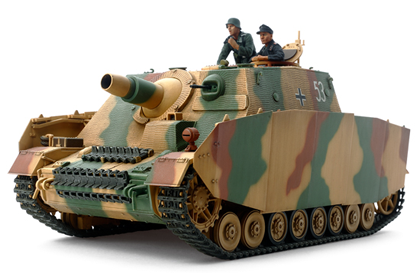
German Brummbär (Late production) (Tamiya)

This is the Tamiya 35 353 kit in 1/35 scale, of the ‘German Brummbär (Late production)’.

German Brummbär (Late production)

History

Developed for infantry support during WWII, the Assault Tank IV married the trusty Pz.Kpfw.IV chassis with a simple fighting compartment featuring 100mm of front and 50mm of side armor, plus a high-powered 15cm gun that could defeat 160mm of 30-degree armor from 5km.

Its variants can largely be grouped into early, mid and late production types, the latter of which was most numerous with 160 examples manufactured between May 1944 and March 1945. Feedback from crews of earlier Brummbärs had led to new a fighting compartment design and cupola, plus partial use of steel road wheels.

Brummbärs were assigned to their own dedicated Assault Tank Battalions and fought on the Eastern Front and in Italy as the war drew to its conclusion.

Source: Tamiya website

Manufacturer

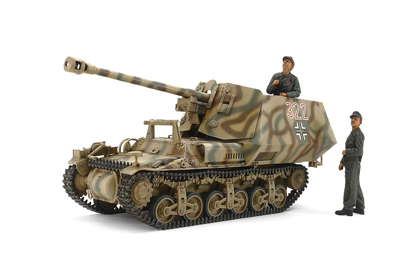
German Marder I (Tamiya)

This is the Tamiya 35 370 kit in 1/35 scale, of the ‘German Tank Destroyer Marder I’.

German Tank Destroyer Marder I

History

With the fall of France in June 1940 Nazi Germany came into not only new territory, but also a large amount of captured materiel.

Many of the French armored vehicles were pressed into German service, including the Marder I. It was based upon a late-1930s Lorraine tractor vehicle, paired with the German 7.5cm anti-tank gun and based in a new fighting compartment installed on top.

The Marder I fought on numerous fronts in WWII and its offensive potential made it a foe for Allied forces to fear.

Source: Tamiya website

Manufacturer