This is the Tamiya 35 025-500 kit in 1/35 scale, of the ‘Sand Bags set’.
Where I got it
- Stoppel Hobby (October 2018)
This is the Tamiya 35 025-500 kit in 1/35 scale, of the ‘Sand Bags set’.
This is the Trumpeter 00389 kit in 1/35 scale, of the ‘German Bergepanzer IV, Recovery Vehicle’.
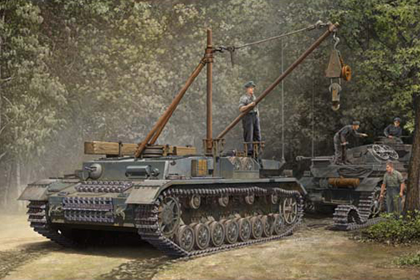
Bergepanzer IV : A recovery vehicle, essentially a turretless Panzer IV chassis fitted with a crane. In May 1944 Bergepanzer 36 stared being built.
This is the Trumpeter 05553 kit in 1/35 scale, of the ‘KV-220 Super Heavy Tank’.
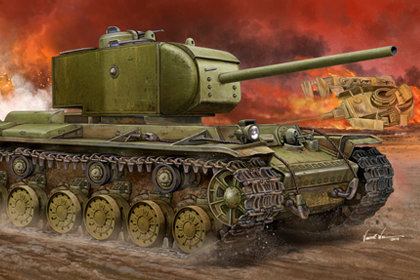
New diamond-shaped turret. 85mm F-30 cannon. One prototype was constructed in 1941. The tank was lost in battle.
The KV-220-2 had its turret removed (The turret and KV-220-2 were both used in the defense of Leningrad) it was fitted with a KV-1 turret and F-32 cannon. The tank was lost in battle, supposedly later repaired, and sent to a training unit.
This is the Zvezda 3641 kit in 1/35 scale, of the ‘German Panserkampfwagen IV, Ausf. E’.

The Panzer IV was the most widely manufactured German tank and the second-most widely manufactured German armored fighting vehicle of the Second World War, with some 8,500 built.
The Panzer IV chassis was used as the base for many other fighting vehicles, including the Sturmgeschütz IV assault gun, Jagdpanzer IV tank destroyer, the Wirbelwind self-propelled anti-aircraft gun, and the Brummbär self-propelled gun.
This is the Zvezda 3580 kit in 1/35 scale, of the ‘Russian Tank T-34/76, with mine roller’.
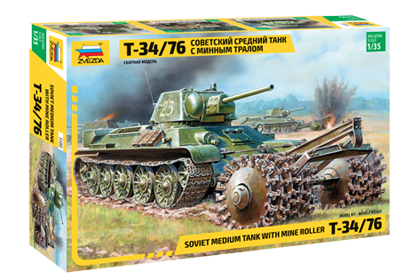
The supreme command ordered urgently the development of a mine clearing device.
At that time the T-34 and its variants were the most widely used tanks in the Soviet Army. So it was logical to adapt the T-34 as carrier. This combination was then successfully in service through the whole WWII.
This is the Zvezda 3535 kit in 1/35 scale, of the ‘Russian Tank T-34/76’.
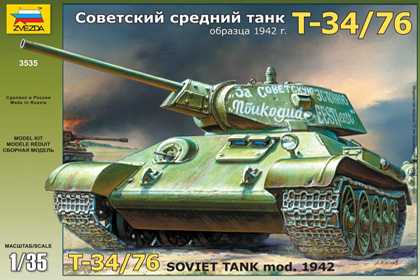
The initial T-34 version had a powerful 76.2mm gun, and is often called the T-34/76.
The T-34/76, like many other contemporary tanks, had a two-man turret crew arrangement. This required the tank commander to aim and fire the gun while having to coordinate with other tanks and potentially also being a platoon commander, and proved to be inferior to the three-man (commander, gunner, and loader) turret crews of German Panzer III and Panzer IV tanks, which allowed the tank’s commander to concentrate solely on that job.
This is the MiniArt 35169 kit in 1/35 scale, of the ‘German Pz.Kpfw.III Ausf. D’.
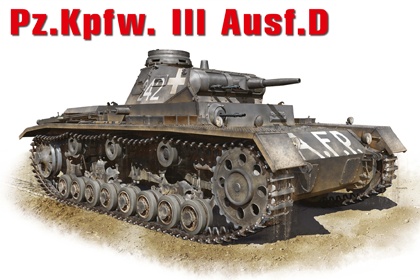
The official German designation was Panzerkampfwagen III Sd.Kfz.141 (abbreviated Pz.Kpfw.III) translating as “armoured fighting vehicle”. It was intended to fight other armoured fighting vehicles and serve alongside the infantry support Panzer IV.
From 1942, the last version of Panzer III mounted the 7.5 cm KwK 37 L/24, better suited for infantry support. Production of the Panzer III ended in 1943. However, the Panzer III’s capable chassis provided hulls for the Sturmgeschütz III assault gun until the end of the war.
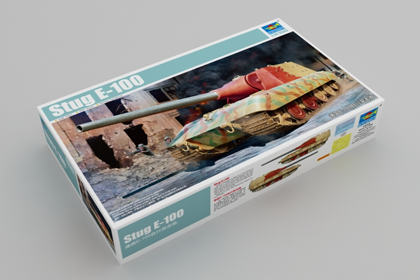
This is the Trumpeter 09542 kit in 1/35 scale, of the ‘German Super Heavy StuG E-100’.
This is the Tamiya 35 233-3000 kit in 1/35 scale, of the ‘German Flakpanzer IV Wirbelwind’.
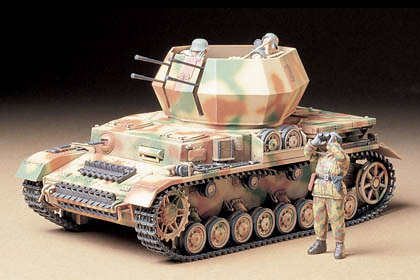
The Panzer IV’s turret was removed and replaced with an open-top, nine-sided turret that housed a quadruple 2 cm Flakvierling 38 L/112.5. A closed-top design would have been preferable, but this was not possible due to the heavy smoke generated by the four anti-aircraft guns. The shape of the turret earned it the nickname Keksdose (“Biscuit Tin”).
The combination of armor and rapid fire from the four guns of the Wirbelwind made it very effective against lightly armoured ground targets such as trucks and armored cars; infantry were particularly vulnerable.
This is the Tamiya 35 017-2800 kit in 1/35 scale, of the ‘German 88mm Gun FlaK 36/37’.

The 88mm gun (commonly called the eighty-eight) was a German anti-aircraft and anti-tank artillery gun from World War II. It was widely used by Germany throughout the war, and was one of the most recognized German weapons of that conflict. Development of the original models led to a wide variety of guns.
The name applies to a series of guns, the first one officially called the 8.8cm FlaK 18, the improved 8.8cm FlaK 36, and later the 8.8cm FlaK 37. FlaK is a contraction of German Flugzeugabwehrkanone meaning “aircraft-defense cannon”, the original purpose of the eighty-eight. In English, “flak” became a generic term for ground anti-aircraft fire. In informal German use, the guns were universally known as the Acht-acht (“eight-eight”).
The versatile carriage allowed the eighty-eight to be fired in a limited anti-tank mode when still on its wheels; it could be completely emplaced in only two-and-a-half minutes. Its successful use as an improvised anti-tank gun led to the development of a tank gun based upon it. These related guns served as the main armament of tanks such as the Tiger I: the 8.8cm KwK 36, with the “KwK” abbreviation standing for Kampfwagenkanone (literally “battle vehicle cannon”, or “tank cannon”).
This is the Trumpeter 05575 kit in 1/35 scale, of the ‘Russian Project 704 SPH’.
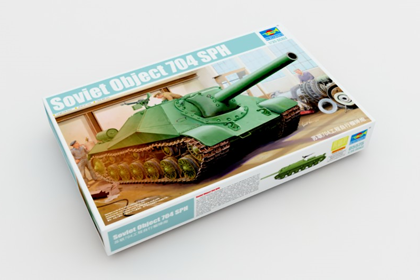
The self-propelled gun carried 20 rounds of two piece (shell and charge) armor-piercing and high explosive ammunition. The secondary armament of the fighting vehicle consisted of two 12.7 x 108mm DShK machine guns, one anti-aircraft and one co-axial.

Aftermarket metal wheels for my American vehicles, in 1/35 scale.
Please verify the vendor’s website, before using the information below
Light |
|||||||
| M3 Stuart | |||||||
| M24 Chaffee | AW-21 | ||||||
| M41 Walker Bulldog | |||||||
| M551 Sheridan | |||||||
Medium |
|||||||
| M4 Sherman | |||||||
| M46/M47/M48/M60 Patton | |||||||
| M1 Abrams | ATL-155 | ||||||
Heavy |
|||||||
| M26 Pershing | |||||||
Destroyer |
|||||||
| M18 Hellcat | |||||||
Artillery |
|||||||
| M44 Howitzer | |||||||
| M53/M55 Howitzer |
Source: Friulmodel